

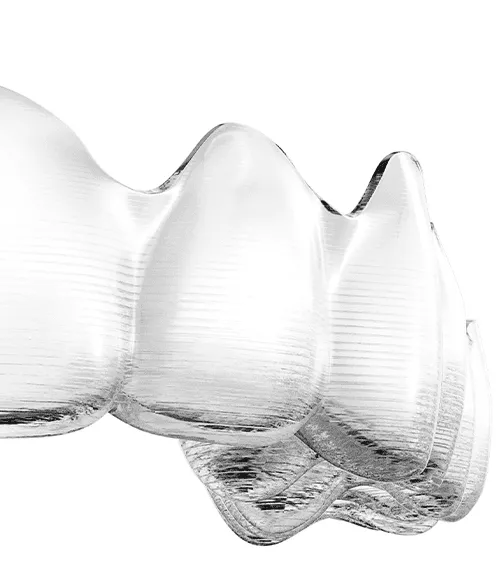
What Vivera Retainers Are
Vivera retainers are clear, removable retainers made by Align Technology, the company behind Invisalign. They look much like a clear aligner but are made from a thicker, more durable material, because a retainer’s job is the opposite of an aligner’s: an aligner is meant to move teeth, a retainer is meant to hold them exactly where they are.
The material is the main practical difference from a standard clear retainer. Vivera is manufactured from a stiffer multi-layer plastic that resists cracking and wear better than typical vacuum-formed retainers, which are made in-office from a single sheet of plastic heated over a model of your teeth.
Why They Are Ordered in Sets
Vivera is typically supplied as a set of four identical retainers per arch. That is the feature most patients end up appreciating most, because retainers get lost and broken with remarkable regularity.
Having spares at home means a lost retainer is a minor inconvenience rather than a scramble to be re-scanned and wait for a replacement. The window matters: teeth begin drifting within days of stopping retainer wear, and two weeks without one is usually recoverable while a couple of months often is not.
Cost, and How to Compare It
Vivera costs more upfront than a single in-office clear retainer, and less than buying four in-office retainers one at a time. That is the comparison that actually matters.
If your treatment fee includes an initial retainer, ask what it includes specifically — one arch or both, one retainer or a set — and what an upgrade to Vivera would cost. Then ask what a replacement costs in each system. A patient who loses a retainer every couple of years is in a very different position from one who has kept the same one for a decade, and only you can predict which of those you are.
Some practices also offer a retainer replacement program: a set fee covering periodic new retainers for a number of years. Whether it represents value depends on the price, but it is worth asking about at your debonding appointment rather than after the first one disappears.
How Long a Set Lasts
With nightly wear, a single Vivera retainer commonly lasts well over a year, and a set of four can cover several years. Lifespan depends heavily on two things: whether you grind your teeth at night, and how you clean and store it.
Heavy grinders wear through any removable retainer faster, and that is worth mentioning to your orthodontist — a different retention plan, or a nightguard-style appliance, may suit you better.
Caring for Them Properly
Rinse in cool water every time the retainer comes out. Clean it daily with a soft brush and a mild soap, then rinse thoroughly.
Do not use toothpaste. Toothpaste is abrasive and scratches the plastic; scratched retainers cloud over, hold stain, and harbor bacteria. This is the single most common reason a retainer looks foggy after a few months.
Never expose it to heat. No hot water, no boiling to “sanitize” it, no dishwasher, no leaving it on a car dashboard or a radiator. Heat warps the plastic permanently, and a warped retainer does not fit — which means it is no longer retaining anything.
Soak occasionally in a dedicated retainer cleaning solution or a diluted vinegar solution to manage mineral buildup and odor. Avoid mouthwash with strong colorants, which can stain the material.
Keep it in its case whenever it is not in your mouth. The two great destroyers of retainers are restaurant napkins and household dogs, in roughly equal measure — a dog will find a retainer left on a nightstand, and it will not survive.
The Wear Schedule That Actually Protects Your Result
Most patients wear a retainer full-time for a period after braces or aligners come off, then transition to nights only. Nights only is then indefinite, because teeth drift throughout life whether or not you have had orthodontic treatment. Lower front teeth crowding with age is one of the most reliable patterns in dentistry.
Wear it every night, not most nights. By the time a retainer feels tight, movement has already happened.
What to Do When One Cracks or Goes Missing
If you have spares, move to the next one immediately and let the office know so a replacement set can be planned before you run out.
If you do not have spares, call promptly rather than waiting. Do not attempt to repair a cracked retainer with glue — household adhesives are not safe in the mouth and a patched retainer does not fit accurately, which can actively move teeth in the wrong direction.
If a retainer suddenly will not seat after a period of not wearing it, do not force it. Forcing a retainer onto teeth that have shifted can cause discomfort and, occasionally, unwanted movement. Bring it in, and we will assess whether a new retainer at the current position is appropriate or whether a short course of treatment is needed to recover the position first.
Vivera vs. a Bonded Wire
These are not mutually exclusive, and plenty of patients finish with one of each: a thin wire bonded behind the lower front teeth, plus a removable retainer on top.
The bonded wire’s advantage is that it cannot be forgotten. Its disadvantages are that it requires careful flossing with a threader or water flosser, and that it can detach quietly — allowing teeth to move while you assume you are protected. Have it checked at your dental visits.
A removable retainer’s advantage is that it covers the whole arch and is easy to inspect and clean. Its disadvantage is that it only works when worn.
Common Questions
Can I whiten while wearing them? Ask first. Retainers are not designed as whitening trays and some materials are affected by gel.
Will my retainer fix teeth that have already shifted? No. A retainer holds a position; it does not correct one.
Can I eat with it in? No. Remove it to eat and to drink anything other than plain water.
How many hours a night is enough? A normal night’s sleep. Consistency matters more than counting hours.
Questions About Retention?
Read about retainers, aligner and retainer care, or request a free consultation.